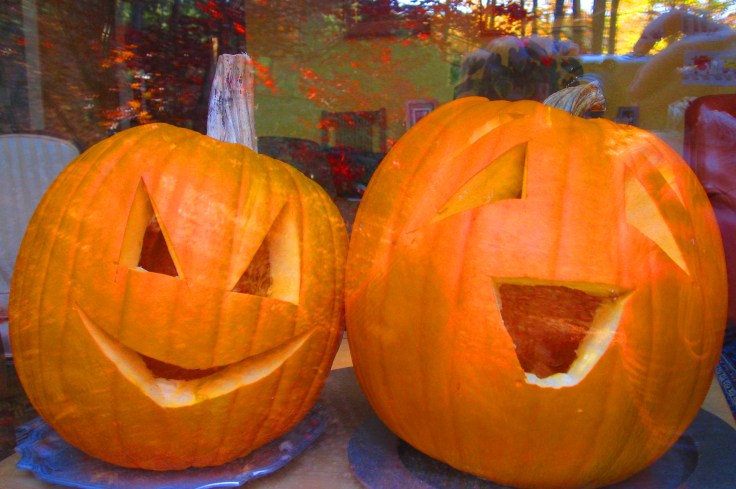
Smiling Jack O’ Lanterns – the best part of Halloween.
Twenty First Century Writing
Smiling Jack O’ Lanterns – the best part of Halloween.

Election night 2006. That’s Deval Patrick on the jumbo screen at right, emerging triumphant in his victory as the first person of color to be elected governor of Massachusetts. The campaign slogan was Together We Can. The headline in today’s Boston Globe was that he will cut 1,000 state jobs to avoid a budget deficit of $600 million. He didn’t create the recession, but there is still something terribly disheartening about this news. Families of people with disabilties will lose the people who support them, more teachers will lose their jobs, more schools will be overcrowded, and politicians – the Governor included – may use this as an excuse to build casinos in Massachusetts. He is sinking in a quagmire not of his own making, and signs point that he is looking to all the wrong people to pull him out. I don’t blame him for not getting along with his own legislature – even though his party holds the majority – but, just as with Obama, I wonder if he has been able to surround himself with people who are truly like-minded.
That election night was an interesting moment in time. Ted Kennedy spoke (boring boilerplate), as did John Kerry (deadly boring boilerplate – leftover from 2004 Presidential campaign) and Martha Coakley (most boring of all attorney general-speak that she still uses in her current campaign to fill Kennedy’s Senate seat). Patrick was the beaming exception. Like Obama – he literally lit up the room.
Still, my favorite moment from that night did not take place on the floor, but in the empty corridor outside as my daughter and I were going out to find something to eat before the speeches began. It was one of those enormous convention center hallways that could accomodate a truck if it was required, and walking toward us was a man in a red pullover sweater. He looked familiar and I squinted to get a better look. He smiled at me and, not breaking his easy stride, smiled and said “Hi there, how are you?”
“Fine, thanks.” I nodded and returned the smile as we passed each other.
My daughter looked at me, and said “Who was that? It seemed like he knew you.”
“That, my dear, was Mike Dukakis. And he was once the Democratic nominee for President of the United States. I’ve never met him before, but that’s what good politicians do – they make everybody feel like them know them.”
“That guy in the red sweater walking all by himself?”
That guy in the red sweater walking all by himself.
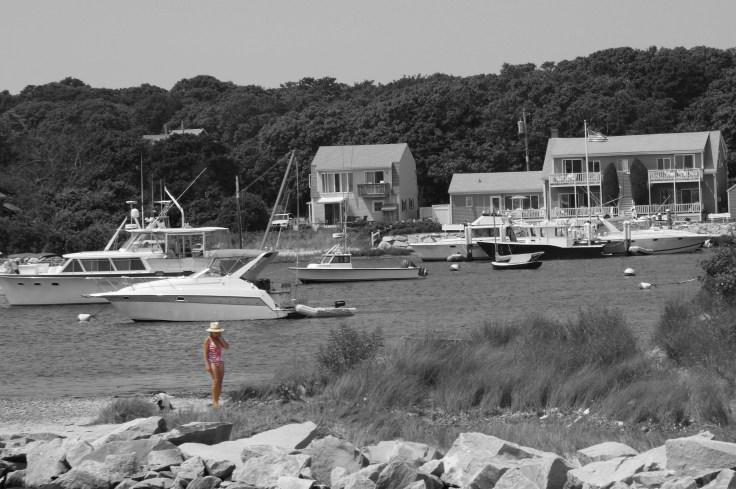
I’m not quite ready to give up on Summer yet, and this moment captured from the Island Queen ferry as it pulled into Oak Bluffs captures the essence of the 2009 Obama-rama on the island of Martha’s Vineyard. Taken just a few days before the Obamas vacationed on the Vineyard last August, the woman with hat and cellphone among boats large and small pretty much said it all.
 I heard a voice on the radio last week that sounded like a folk singer who used to work for me when I was at MIT. It was an odd match – she was this tremendously talented woman in her 30s trying to pay the bills so she could pursue her art and music and I was an ambitious twenty something newly ensconced in a senior position in the President’s Office. I was advised by one of my superiors that I was expected to prove myself with the subtle warning “not to let my slip show.” So I hired Suzanne because she was bright and funny and seemed to understand teamwork, and I needed all the help I could get.
We both had a lot to learn, it turns out, and in the years since we parted ways I often think of her as I pursue organic gardening and alternative therapies because she was on the leading edge of these things way back in the 90s. Me, I was on the leading edge of a nervous breakdown, and loving every minute of it. I loved the meetings (it’s true, I love meetings), the policy discussions, the intellectual give and take of some of the most interesting and fascinating minds of our time – Lester Thurow, Paul Krugman, Bob Solow, John Deutch (pre-CIA), Francis Low, Philip Sharp – I only took notes on the discussions but I relished the immersion in ideas, and I gloried in taking it all down and getting it just right.
Suzanne was helpful in her wry way but clearly less enamored of the process than I. Part of our job was to prepare for meetings, sending out agendas and prep materials and copies of the meetings notes. To keep all of our groups straight (for us and for the members, who often sat on several committees), we coded the notes and agendas, assigning each committee their own color – yellow, green, blue, pink, goldenrod. There were long hours in the windowless copy closet down the hall, and we had to lug our own colored paper with us each time we traversed the infinite corridor between our office and that room. It was a pain.
Late one winter afternoon I dispatched Suzanne down the hall with a ream of pink paper to copy agenda and notes. She returned with the notes, and each set had the first two pages in pink paper and the subsequent three in white. There it was, my slip showing, a bit of white peeking from under the pink. I didn’t handle it well.
“What’s with the white paper?”
“I ran out of pink and so I just finished them in white.”
“Are we out of pink?”
“No, I just didn’t want to walk all the way back to get more.”
“Well, we have to redo them so they are all pink.”
“You can’t be serious.”
“No, we really have to. We cannot send out two-tone notes. It’s sloppy work. We just can’t.”
“You’re just going to throw away all this paper because it’s the wrong color.”
“No, we’ll recycle it. The notes absolutely must be all in pink.”
“You’re going to WASTE all of that paper and time and work just so they can be all pink?”
“If you were worried about wasting paper and time you should have come back down the hall for more pink paper.”
We were both furious. I made her stay late and redo it herself. I didn’t even help. It was then that I realized that I did not like being a supervisor and that I was not very good at it, either. Eventually, Suzanne went on to work for a brilliant music professor and we parted on good terms. After hearing what I thought was her voice last week (it wasn’t) I learned that she left New England to pursue her art and music and, from what I can see on her website, she looks well and happy, and I am glad. She taught me a lot, and I drove her crazy. Okay, maybe we drove each other crazy.
I still have pink paper moments all the time. Moments where I would rather do things myself instead of harangue my kids, where I insist on things being done a certain way, and I still find myself wondering if my slip is showing. I reconsider that exchange where I demanded the recopying often, at those moments in which attention to detail may seem over the top but that the urge to do something – anything – precisely right is overwhelming. On some days, doing the little things right is all I am able to get done at all.
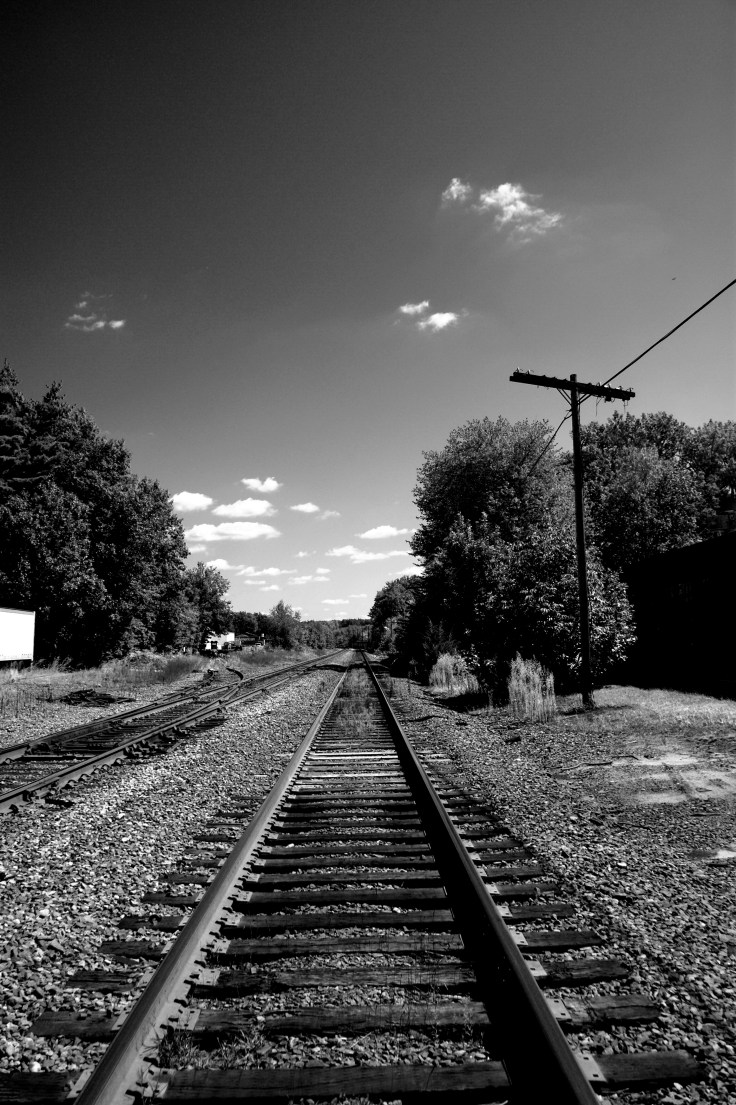
Commuter Rail tracks at Groton-Harvard Road, Summer 2009.
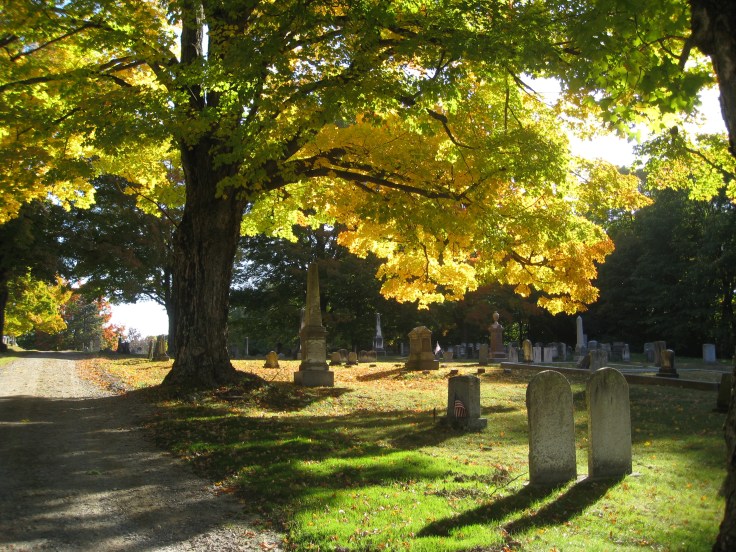
Each season I visit this cemetery to record the quiet majesty of old stones and ancient trees. Today I was there with friends to bury someone so stalwart it is impossible to imagine she has left us. Next week we will have a new cemetery to visit and a beautiful young woman to comfort. She lost her father in the space of a moment. Maybe we all do. It’s just a matter of which moment we realize it.
As we drove home from dinner last night in the autumn darkness I noticed something on the windshield through the sleet – little circles that caught the light from the oncoming traffic. This morning I glanced over and confirmed it – five prints on the windshield, large to small, a perfect print of W.’s right toes. On Mondays while we wait for A. to come out of guitar lessons, he often slips his feet out of his shoes and socks and puts his feet up on the dash, wiggling his toes and grinning up at me mischievously.
There is something terribly pleasing about putting your feet up in front of you when you ride in a car or train; I used to do it every morning and evening on the Commuter Rail from Cambridge to Concord, tucking my long skirt underneath me and wedging myself between the seats, my knees up on the one in front of me. I now know that this designates me as “sensory seeking,” a person who seeks direct pressure from physical contact – heavy blankets, warm sweaters, snug turtle necks, bear hugs. But is has to be just right and it has to be my idea or I become instantly claustrophobic. This is where I find W. truly astounding, because even at fourteen he can climb on my lap and it is no more burdensome than holding a baby. Even though I cannot let him stay there (for a multitude of reasons) it amazes me that he can totally get away with invading personal space and can position his body in a way that minimizes the impact of his weight. Maybe we are sensory seeking in just the same way; we attract like magnets, quickly closing the space between us.
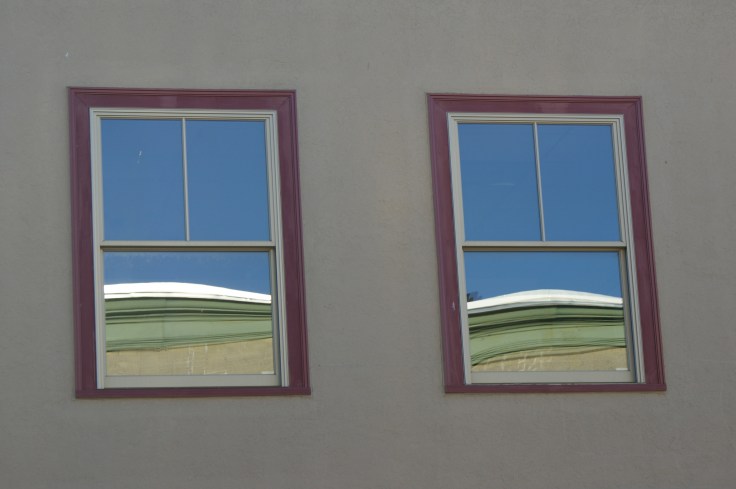
No story here. Just colors and shapes and light that make me unreasonably happy.
Something stirs in the dead zones; cool water on the hot coals of confusion. The steam sears, but it feels good to know emotional complexities again. The spots and crackled skin on my hands comes from over exposure to the sun, but the warmth that is brings is something good. For the first time in a vey long time, I am comfortable in my own middle aged skin.
The stirrings were fleeting at first and are still vulnerable to the snapping jaws of panic, but I can still recall when fear was the only reliable emotion I could access for weeks or months at a time – I had two modes: panic and exhaustion from being panicked all the time. I was able to identify the places where joy and peace would fit, but there was no feeling to put there, and so I filled them with tears that may have looked like happiness but were actually despair at the joy I was incapable of feeling. The numbness is not entirely gone, and sometimes I still fill the slots with the wrong emotions, but in the past year I have felt a broadening, an expansion, like blood flowing into long empty veins. It can be painful, but those pipes that flowed primarily with fear and confusion, now course with hope.
Where all energy went into the suppression of fear, there are stories, words descriptions, curiosities that no longer torment but intrigue. I read and write and the atrophied muscles ache and respond. Slowly.
Recovery has required withdrawal from things and people I know are important. I will have to find a way to keep those connections without allowing such pursuits to short circuit this delicate thread of creative electricity. I worry that it will snap but I know that I will only happen if I allow it.
 LettersHead