Night and the City

We are spending a few days in the city, and one of my favorite parts is the sounds of traffic outside the building at night.  Even the sirens bring back good memories of my years in Saint Louis and Boston, laying in my bed feeling the pulse of the city outside my window, the comfort of people moving about busily, anonymously nearby.  In Saint Louis there was the longing as a young teen – of wanting to be out and about in the night, and then, year by year, getting that chance when I got a job, went out with my friends, learned to drive.  It was all I had hoped even in days when we lived in Iowa and visited Chicago; I would sit on the stone planters near the hotel taxi stand, watching the people and cars go by with such purpose, and longing for my chance to be part of it.  Even farther back, I recall sitting up at night, jet lagged, watching the crazy cacophony of Italian midnight traffic on the Via Veneto.  Later in that trip my brother spirited me away one night to a tiny restaurant up a stone path where we looked at hills and city lights as we ate by candlelight.  For years I thought I must have imagined that night – it seemed so dreamily impossible – the image was so precious I held onto it for a long time before asking him about it and felt such joy to know that it was real and just as precious to him.

And so tonight I look out the window at the full moon above and the cars zipping by below, so happy for this chance to rekindle my romance with night in the city.  Charlie Haden has an album by the same name that is perfect for times like this.

May Your Days Be Merry and Bright

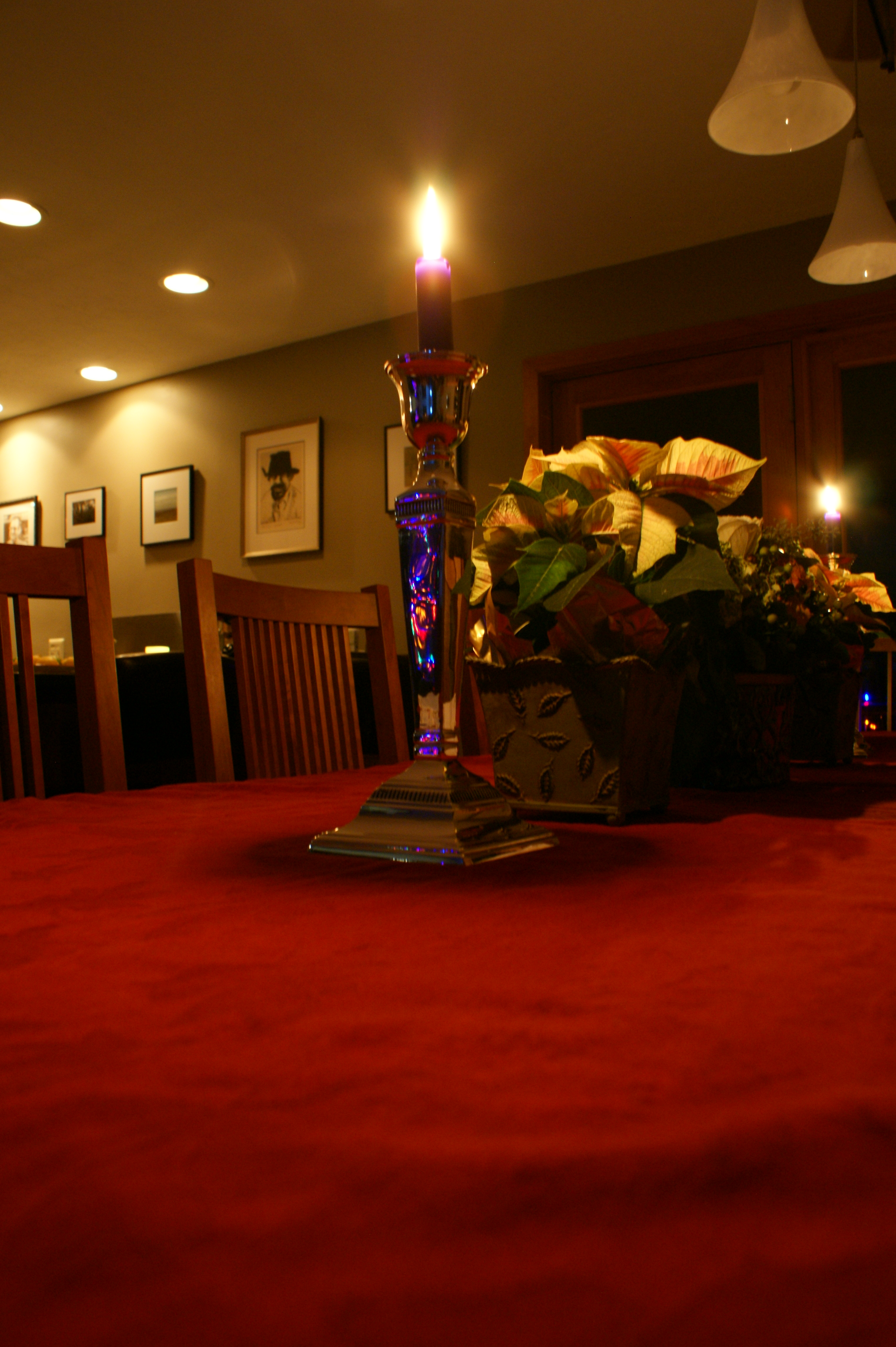
Merry Christmas and Happy Holidays.  We are humbled to have so much and hopeful that the future will bring joy and peace to all who seek it.

Let Them Eat Red Cake

Whatever damage we sustained from overindulgence in red food coloring back in the 70s before it was yanked form the market for being carcinogenic seems to have subsided enough to allow for a resurgence in popularity of Red Velvet Cake.  Red M&Ms reappeared a while back and now the cake, with recipes that call for less of the now safer red dye (but still a whole bottle nonetheless).  Our mother’s birthday was on July 3, and she made red cake each year to take to the party up on the Cedar River on the 4th.  Because this cake tastes especially good cold (it’s the cream cheese frosting), and the colors are right, it is really a great summer cake.  And, as it turns out, nice for Christmas.    I had misplaced the recipe that Mom used and recently found it in a recipe book put together by the Cook’s magazine folks.  I will post the recipe itself on Parsenip later this week.

Scaffolding

I’m a little slow on the uptake.  Yesterday it occurred to me that we have spent the last sixteen years carefully constructing scaffolding around our children, trying to raise them smartly, lovingly, safely.  And now, now that we are enjoying those revelatory moments in which they think things through, do the right thing, ask good questions, and fall in love with the outside world, we must watch them dismantle that structure that we built so carefully, and sometimes have an active role in taking it down around them.  I held on to a conceit that I could supply guidance and instill confidence when they need it, but now I see so clearly that there are steps – lots of them – they have to take beyond my view and that those steps include tasks I looked forward to doing myself that I must now entrust to others.  I knew that the process of building independence would be easier in different ways for each of my children, but I’m starting to realize that the person I need to build independence for is me.

The Autism Beat – The Flip Side

Well, after making it sound like I live in a war zone I really should say why I love what autism has brought to my life.  Years ago, when I had an inkling that my life as a parent would be somewhat different than I expected, I plopped myself down at a friend’s kitchen table, and said “I don’t want this to change me; I don’t want to become angry; I don’t want to become the kind of parent that other parents avoid.”  Well of course it did change me and there are moments when I am angry and there are parents who avoid me, but I know all of that would have  happened anyway, regardless of whether I had a special child or not.

But what I didn’t know was that my life would have more texture and incidental joy than I could ever imagine.  That my child brings as much joy to others as we give love to him, that for every unexpected thing he does we learn something unexpected about ourselves.  We learned that it is impossible to parent any two children in the same way, that consistency is not about rules but about stability.  That believing what you say is just an important as the words you are saying.  That children often teach each other better than adults teach children, and that there are some children you can parent instinctively and other children that you have to seek help to learn to parent them well.  I have been quicker to understand and slower to judge, but less tolerant of those who might be quick to presume they understand me.

I learned to think in pictures, that emotions are a language unto themselves, that I can listen and speak with my eyes, and the practical value of being able to memorize dialogue from movies and TV.  I’ve learned the hidden language of touch, and that each person speaks it differently.  I’ve had spoken conversations for hours and gotten nowhere; I’ve made months of progress in a few moments of holding hands.  The two most important things in life are sleep and a sense of humor, followed closely by coffee and the internet.  With these things, I have found ways to help my family, stay connected with people I love, and found my way back to being the person I always hoped I could be.

When I look out from my life at the lives of others, I don’t see people who have it better than me – I see some people who think they have it better than me.  Everywhere I turn, people are still having mid-life crises, still worrying about their kids, still dealing with their parents (living or dead), still searching for something.  Sometimes I think people manufacture problems out of sheer boredom.  So, even as I struggle to create balance in my life, I am acutely aware of what I have and the bounty of my blessings.  Autism has given me the freedom to do what I think it right because there is no map for this life – I looked everywhere and I asked everyone and nobody knows.  That’s the gift:  the challenge of unraveling the mystery, of being able to write about it, of finding those marvelous people who speak our languages and who are on a similar journey, and who are laughing all the way with us.

The Autism Beat – Living with Improvised Explosive Devices

A while back, someone sent me a link to an article that said that mother’s of kids with autism have the same type of stress as combat veterans.  This is not news, but it’s nice to have this kind of twisted validation.  I showed it to my husband, and he laughed and said “No kidding, we live with an IED.”  Exactly.  It’s the perfect illustration of what living with autism is like – you live under the same roof as an Improvised Explosive Device.  Just walking past – even a conversation with another person – can cause a freakout.  It’s like those phantom light switches that don’t turn anything on – some unsuspecting soul in China flips a switch and your child ignites.

To be fair, there are also parallels with living with teenagers, but with teens you can bet that eventually they will just give up and go to their room, or – better yet – stop speaking to you.  With just about any typical child, you can win the occasional argument, but that is not true with autistic people – if you decide that you are going to win they raise the stakes so high you have to rewrite the concept of what winning means- for you.  In our family we have dubbed this the Pizza Kid rationale.  Several years ago an autistic teen left his grandparent’s house and hid in the woods for five days because they had refused to have pizza for dinner.  Five days. He was never lost – he watched people look for him while he hid, and finally, finally got hungry enough that he didn’t have the strength to elude them any more.  You have to admire him for refusing to lose, but when it’s your own family, and for their own safety, you still can’t let them gain control.  So you barter – it’s really the only thing that works with anyone, but you have to be much more transparent in your motives because to people with autism it’s not about winning – it’s about keeping their world the way they need it to be.  Perhaps what is most unnerving of all is the randomness of it – the improvised part – what is crucial to them one day might not matter in the least on the next.  They need to control everything if they are going to survive, and you are the one who can provide the order they crave, or disrupt it.  So it has to boil down to life via contract – I will trade you this for that.  And even then there are times when they are so freaked out by the vagaries of life – bickering siblings, changes in schedule, bad weather – that they can’t even cut a deal, and the house of cards collapses – BOOM!

But there is a silver lining to this thundercloud.  You learn a lot about yourself and a lot about what motivates people of all abilities.  You learn the power of your own fear and the power of someone else’s, and that managing fear – yours, their, everyone else’s – is what 99% of your struggles with autism amount to. If you can find ways to keep either one of you from being afraid, of the world, of uncertainty, of each other, eventually, hopefully, you can put the flack jackets away.

The day after I drafted this essay the New York Times ran a front page story about a boy with high functioning autism who rode the subway for eleven days because he didn’t want anyone to yell at him.  This is not a closed topic.

Signs of the times

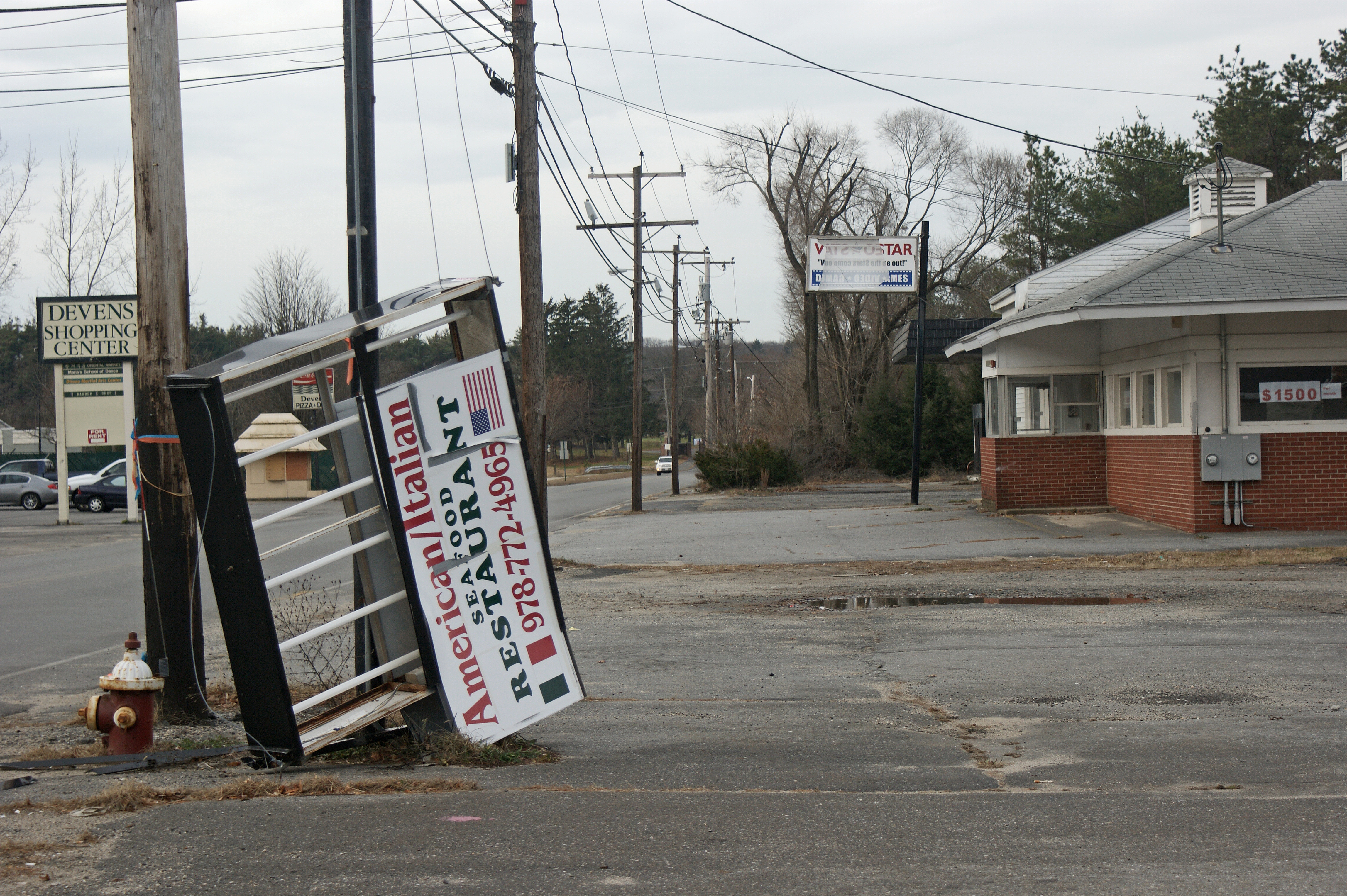
This section of Ayer, Massachusetts, abuts the former Fort Devens.  The area has been struggling ever since the U.S. Government closed the base in the 1990s.  While the Devens Redevelopment Authority (it still has an Army Reserve Unit which houses lots of desert camo hardware – trucks and tanks and the like) has had some success in drawing businesses and a charter school to relocate or build there (with major tax incentives and subsidies from the state) the recession has nonetheless taken a continuing toll on the surrounding communities, which built their infrastructure throughout the 20th century on the population of soldiers and their families who lived near or on post.

Required Reading: Modern Love

The Modern Love column runs every week in the Sunday Styles section of the New York Times.  Anyone can submit a column, and whomever chooses among the submissions does an incredible job, because it is always worth reading.

Revisionist Parenting

When I was nineteen I had a major crush on a boy I met at a summer job in Michigan. He was smart, sweet, earnest, funny and boyishly hadsome. We were inseparable for much of the summer but did not exchange so much as a kiss – it was fun; I thought it had potential. At the end of the summer we cooked up a plan to visit my family in Missouri before returning to our respective colleges. I knew my mother would like him, and she did. The feeling was mutual, I guess, because on the first evening at our house he said to me, ” When I met you I thought you were such a unique person, but now I realize that you are really just like your mother.”  I should have known at that moment that the romance was doomed; he entered the seminary the following year.

Fast forward twenty-seven years. My husband sits down in front of the family computer situated at the desk that I use, and looks at me and says, “Look at the way you have all of your notes and photos up on this wall and all of your papers here – you are your Mom.”   He is smiling – he loved my Mom. “I think you do it on purpose.”

Well, I didn’t; I don’t. I make rolls like she did on purpose, I speak truth to power like she did on purpose, I try to make my home welcoming like she did on purpose. But as my hair goes grayer and the questions from my children get thornier I find it maddening for it to be so hard to lift myself out of her ruts in my road – she did not overtly impose her ways on me and there are so many ways in which our paths greatly diverge.  I know we have faced the challenges on our lives in fundamentally different ways.   And yet, her influence is an incredibly strong default mechanism. It can make me frustrated, because in the years since her death I have begun to understand how she crafted the myth of herself by selectively sharing information with her children. But I also can empathize with why people do that – there are so many conversations that people will do anything to avoid. Parenthood doesn’t have a full disclosure clause, and the line between honesty and too much information is constantly shifting. When you share you risk two responses:  “Why did you tell me this?” and “Why didn’t you tell me this sooner?”  I have been through this with my own children over the most minor events already, and perhaps I do share too much.  One person’s enlightenment is another’s burden, one person’s honesty is another’s pain.  You never know.

I witnessed enough drama in my Mom’s life to know that, as her youngest, I missed plenty. I wasn’t very good at letting those moments I did know about fade; I have a penchant for rehashing events in hope of prying out more details, reasons, answers. I keep looking for a version of the truth that I can live with, knowing full well that my ability to live comfortably with any truth changes from day to day.  What is acceptable in one moment is decidedly lacking in the next.  Sixteen years ago, I spent weeks camped out in my living room with my Mom, quizzing her about her life while we waited for my overdue baby to arrive. We covered a lot of ground, but I noticed gaps in her memory that I attributed to advancing age. It doesn’t really matter what she kept to herself, it is that she made that choice – repeatedly – that caught me off guard as the details emerged in later years after her death. He legendary candor was not what I thought and some of the things and people she put faith in were, to my mind, not worthy of her devotion.  She didn’t owe me full disclosure, but some examples she tried to set have not entirely stood the test of time, either, because she obfuscated.

But these things are true of all parents, all families.  For when we tell a story we are telling our own version, and that, by design or not, means that anyone else who was there as there may or may not agree.  We have a large family – something as simple as a Thanksgiving Dinner in 1975 can come off as Rashomon on steroids.  And I know that, quite often, there are plenty of good reasons to let sleeping dogs lie.  And so I struggle to calibrate what memories are rightfully mine, what traits I truly own, how I can understand what it is to write honestly knowing that truth in memory is only our own version of the facts at a particular moment in time.

I will always love and admire my mother, and there are many ways that I am glad to be like her.  Still, even in the throes of middle age, it is difficult to know where she ends and I begin, and I am reminded of what she said in the weeks before her death.  “You’re going to be forty,” she said as she spoke of her terminal illness, “this is a good time for me to go.  It will be a liberating experience.  When your parents are gone you are truly free to make your own choices.  I never really felt like a grownup until both of my parents were gone.  It’s a good thing.”  Now, I think I know what she meant.
Sometimes, Food IS Love

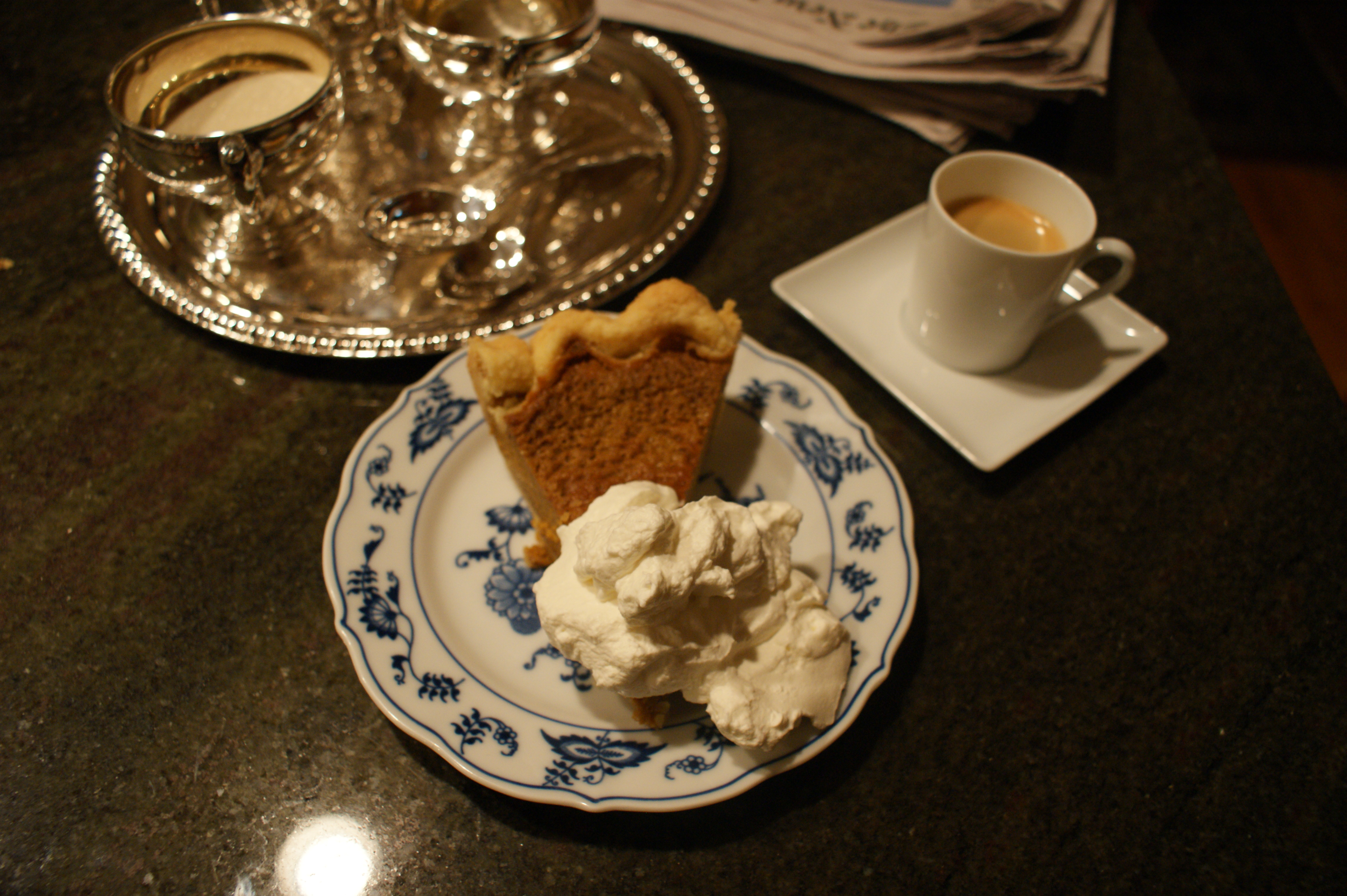
I don’t care what they say, it’s all about the whipped cream.  One of my best early childhood memories is sitting in my highchair parked in front of a cut glass bowl of whipped cream.  Total bliss.

Website Powered by WordPress.com.

Up ↑