Winter Storm Warning

I know it’s getting to me when. . .

  • I look at my calendar and try to think of reasons to get out of every appointment on it.
  • I tell everyone on Facebook to put out their flags for Veteran’s Day and promptly forget to do it myself.
  • My family has to get their clean underwear (and pretty much anything else) from the huge pile of unfolded laundry in the corner of my bedroom.
  • Making the bed means the bedspread is pulled up over the pillows.
  • The fridge looks like my Mom’s – four cartons of half and half (two open), three half-empty bottles of ketchup, six pounds of butter, eight kinds of salad dressing, three bottles of beer that no one likes, cheese with sell by dates from last June and no milk.
  • I don’t care if W. takes his stuffed Wallace & Gromit sheep to the restaurant and gets an extra seat, napkin and menu for it.
  • I stop watching The Daily Show and the Colbert Report.
  • I do all of my reading online.
  • I am more interested in my Farmville Garden on Facebook than I am in my actual garden.
  • Salad consists of lettuce and cucumber.  Every night.
  • I don’t like answering or talking on the phone.
  • I give one-word answers to questions:  “Okay.”  “Fine” “Thanks.”
  • I avoid opening any e-mail with “autism” in the subject line.
  • I buy a whole pomegranate.

More than Veterans

Mom with Lou Friend and Bob Hogan 1943

Last week I wrote about my father’s Navy service (see Overseas) and so today a moment to honor not simply service to our country but the many ways it shaped and created countless lives.  World War II created social structures (our mother with friends at right) and set the stage for a generation that would truly change the world.  A kiss to those who served, and to those who love them.

Here is a link to a new, beautiful song by Mark Knopfler (of Dire Straits fame) to commemorate Armistice Day.

It came from The Old Orchard. . .

Fall 2009 - gnarled apple trees

This apple orchard has been left to its own devices for several and it looks as if the gnarled old trees are emerging from the ground in a Tim Burton-esque quest for revenge.  Who knows what arsenic-laden secrets lay beneath, but they seem to be aching to tell a story no one is ready to hear.

Skunk rolls

Fall 2009 - Skunk Roll bakedWhen Ruth Casey came to babysit, I hid under the bed.  It was nothing personal, really.  As the youngest in a large family, I relished being home alone with my mother when all the other children were in school, and Ruth Casey robbed me, the nursery school dropout, of those precious moments.  If I stayed under the bed long enough maybe my mother would give up and stay home.

Mom was justifiably annoyed at me for my awful behavior when Mrs. Casey arrived.  She was a friend of the family, a well turned out woman with nicely coiffed white hair, rimless glasses and a deep blue suit with pretty buttons down the front of the jacket.  She had a throaty voice that squeaked a little when she laughed, which reminded me of the Andy Devine (he did voiceovers in cartoons).  She seemed a little scary but in truth I was just reluctant to separate from my mother.  I understand that better now, when my youngest scowls at me when his beloved sitter arrives, though she is more fun-loving than I remember Ruth.  As I kept company with the dust bunnies beneath the bed, I recall wondering why Ruth would possibly want to look after me.  She appeared and acted as though she should have a million other things she could be doing, even as she would read to me and try to coax me into playing games with her, I just couldn’t understand why she was there.

As I got older my admiration for Ruth and my embarrassment at my behavior toward her grew.  Ruth Casey was widely loved and respected in Cedar Falls.   Her full name was Ruth Livingston Casey, and her brother, John Livingston, was an accomplished test pilot in the early days of aviation.  He was said to be the inspiration for the Richard Bach’s 1970 book  Jonathan Livingston Seagull, and the kitschy movie that followed.

Best and worst of all, Mrs. Casey gave us one of our most treasured family recipes, and I probably wrecked that for her, too.  Her crescent rolls are present at every holiday in every household in the our family, where they are known as skunk rolls because as a tiny child I thought the curl of dough over the center of the roll looked like the tail of a sleeping skunk.  They don’t deserve the stinky name – guests at the holiday table are always taken aback by it – but some names just stick whether you want them to or not.  I can only imagine how my new moniker for her rolls went over with poor beleaguered Mrs. Casey.

With their buttery, yeasty aroma wafting through the house, those rolls, more than any other single thing, mean home and love and happiness to two generations of our family.  It took years of watching my mother and then many failed attempts on my own to learn to make them properly (oh, the lost art of proofing yeast!), and now I am teaching my own children to make them.  There is nothing quite like working with the dough, which stretches and collapses with a rhythm of its own as it is kneaded and rolled, buttered and cut, then left to rise under tea towels in a warm sunny spot.  Baked and brushed with melted butter, skunk rolls are the ultimate comfort food, and they are the only food my family begs me to make that does not contain chocolate.

I suppose part of the irony is that watching my mother roll out Ruth’s rolls was one of my favorite contexts for her.  She was such a mix of the traditional and the radical, someone who fought for and railed against tradition; you never knew where she would come out on something but in the end you knew she could make it all sound perfectly rational.  Homemade rolls served right next to the potato buds and raspberry Jello-O with cut up banana floating in it.

I hope that, out in the heavens, Ruth Casey understands that I have come out from under the bed and am doing my best to make amends each time I turn out another batch of rolls.  When my brother comes for Thanksgiving in a few weeks, the first words out of his mouth as her greets me on the front walk will be, “You DID make Skunk rolls, didn’t you?”  Of course.

Apples to Apples

Fall 2009 182

We had family from Homer, Alaska visit recently and the food they say they miss most from the lower 48 is fresh apples.  Verlyn Klinkenborg of the Times elaborates on heirloom apples.

Photo:  Acton, Massachusetts, September 2009.

Overseas

Dad in WW2

This is our mother’s favorite photograph of our father. She kept it under the glass on her dresser, along with dozens of other photos of her children and grandchildren.  The dresser was several feet long, allowing enough surface area for a single column of photographs depicting each child from infancy to adulthood.  The picture of Dad was in the upper right hand corner and must have been covered by a jewelry box or a lamp, because I don’t recall ever seeing it until she carefully removed it from under the glass to give to me shortly after my father died in 1992.

He is sitting near a beach in a tee shirt, his sloping shoulders, relaxing tanned arms down to hands resting on khaki-clad knees.  He seems happy.  From a distance it is not clear whether he is looking at the camera, and one might surmise that he is looking off in the distance.  But upon closer inspection it is clear that his shadowed eyes fixed on the lens, and that makes his smile seem a little more self conscious, more guarded, but upbeat nonetheless.  It was wartime in the Phillipines, after all. 

A few years back Steven Soderbergh directed a film set in World War II (The Good German) which he shot using only cameras, lenses and lighting that were available in 1946.  Soderbergh, spoke in the Times about the use of direct incandescent lighting and the unique, noir-ish quality of the shadows that type of lighting and lens created.  This photograph evokes that style, with deep shadows and warm whites depicting men in manly poses wearing simple, military issue clothing.  The ocean waves behind them provide the only patterns.

Who took the photograph and the identity of the man on the left remains a mystery; my mother didn’t know either, which I find particularly odd.  But it suits his overall story, I suppose, for he was a man with many friends, many stories and a selective memory.  Born and bred in the landlocked Midwest, he left his college career and enlisted in the Navy after Pearl Harbor, and shipped off first to Philadelphia and then to Manila.  I surmise that one of the reasons my mother loved this particular photo is that, besides showing him as he was when they first met, it captures on his face his love of the sea, his joy and satisfaction at being part of something big in a place an Iowa man would never expect to find himself.

But for all of his stories, and his gift for telling them, his war years remained largely a mystery, at least to me.  He watched every WWII documentary, read every book about it, but the only details he shared with us were with maps, showing us the islands he went to, and sometimes the kinds of ships he guided as a harbor pilot.  Some of my siblings, in search of an explanation for the years that followed, theorized that that happened in the war drove him to drink later in his life.  When he lay dying, one of them plucked up all of his courage to ask what happened in the war, what sort of injustices led him to the bottle.  The answer was wholly unsatisfactory.  That was just who he was, he said; there wasn’t a reason, no deep dark secret.  He drank because he liked to, needed to, and he stopped drinking when it stopped helping.  It sounds so simple, so unarguable, when put in those terms.  Even so, there are those that believe he simply was not willing or able to talk about all of his war experiences.   So all we have is the photo hidden in plain sight until it was too late to find out the story behind it.

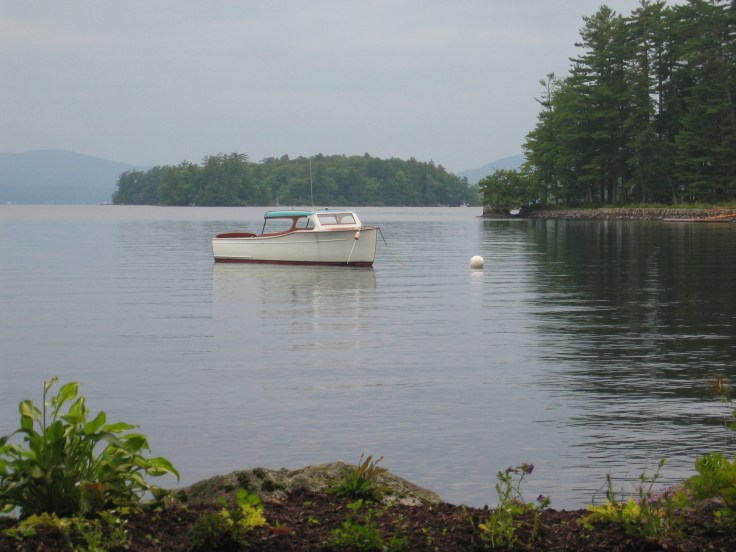
Snow in the forecast, summer in the mind.

Migis Lodge 2005 019

The stillness of Maine visits now and then.  The Migis Lodge is tucked away in the woods in one of the quieter spots on Sebago Lake, and – for a price – creates a sanctuary from another time where people still play shuffleboard and drink lemonade sweetened with maple syrup.  That was 2005.  Now they can probably play shuffleboard, drink lemonade sweetened with maple syrup and check their Blackberries.

Distracted Eccentric

There aren’t any sidewalks in our area of town – people walk on the side of the road, and because New England roads are ridiculously narrow, I usually get a good look at the pedestrians I try not to hit.  One person in particular catches my eye more often than others.  G. wears a baseball cap and a windbreaker with a logo on it, a weathered look to go with his smile and nod as I drive by.  His graying hair curls out from under the cap, a little longish, his mustache, too, a little full.  When I first knew him fifteen years ago G. had a fresh from the barber haircut and clipped mustache, starched button down shirts, blazer and a late model Volvo.

G. is not a victim of hard times, but then again maybe he is.   He is a respected professional who surrendered his license for ethics violations – hubris and nemesis as writ in the early 21st century.  I am nosy; I read the public file on the case.  He was never indicted so it is impossible to say for certain whether he was guilty of poor judgment or something worse, but he made decisions that permitted illegal, sometimes dangerous activities.  It didn’t surprise me completely; he had always seemed bizarrely flip and distant.  He gave strangely vague answers to specific questions:  “What time should the kids be home?” “Whenever you get tired of them just send them back.”  Things like that.  It rankled me enough to tell my own children that they could only go to his home to play if his wife was there.  He didn’t come off as creepy, just as a distracted eccentric.

His sartorial evolution from professional class to working class reminds me that no life has a steady upward trajectory.  I empathize with him even though I am fairly sure he is oblivious to what anyone has ever thought about him.  His peaks and valleys are plain to see, but we all have them and we all try to spin them or hide them in one way or another as best we can.  Some people have the luxury of keeping their travails private, but like G., we cannot – we have a child with a disability, and in order to get him what he needs, we need to tell people more than we want to about our challenges.  It is maddening to have to sit across the table month after month and ask people to lower, raise and rework expectations for a mercurial child; to know that they think you can do better but that they are reluctant to do anything differently on their end.  They probably think I am a distracted eccentric.  The expression of fear mixed with pity is enough to send you to bed for a week.

But G. didn’t go to bed and neither have I.  He found something else to do with his life, and so have I.  Sometimes it means fielding looks from people who will never understand, but sometimes it also means wearing more comfortable clothes.

Website Powered by WordPress.com.

Up ↑